

Ubumuntu - Day 1
Today I left the comfort of my five-star hotel after a buffet breakfast and went to see the Genocide Memorial in Kigali, Rwanda, where about 250,000 of the more than one million Tutsis and moderate Hutus who were killed during the genocide just 32 years ago, in 1994, are laid to rest.
I didn’t expect to be as emotional as I was when learning about the atrocities human beings are capable of. Neighbours were forced to kill each other while the international community watched, commented, and did very little to stop the massacre before or even during the genocide, all while knowing what was happening. This division between Rwandans was planted during Belgian occupation, and the militia carrying out the genocide was trained by the French military.
As a father of two children, the walk through the children’s room hurt the most. Seeing pictures of the lives lost and learning about their favourite sports, foods, and activities humanised the tragedy and brought it home for me.
I learned a new word today: Ubumuntu, which means humanity — goodness, generosity, and kindness. A person who has Ubumuntu is someone who has greatness of heart. We can all be champions of humanity by standing against division wherever we live, and I will teach my boys about Ubumuntu when I get home.
As we drove up to Volcanoes National Park, I started to see news notifications pop up on my phone and realised that, while we should learn from history, we still sit back and comment, tweet, post, watch, and do nothing.
From sadness to awe, the day transformed quickly. Kigali is an exceptionally clean city, and as we drove north we caught glimpses of local culture. We reached 2,400 metres above sea level and entered the dense, wet, and lush forest of Volcanoes National Park. Singita Kwitonda is truly magical. A level of luxury far beyond what is available on other continents and through other brands. Every detail in the service and design is flawlessly executed while staying true to being in Rwanda.
I’m typing this while sitting in my plunge pool, having a cold beer, anticipating tomorrow’s hike to see gorillas.
Big Ben - Day 2
I had been anticipating this day for months. I struggled to sleep and had a 5:30 a.m. wake-up call to make sure I got a full breakfast before heading to the kit room at Singita to gear up for my first gorilla trek. They provide everything you need and even fill your backpack with a safety and comfort kit, water, lunch, and more. It was my first time wearing gaiters, and I wasn’t sure what to expect.
We arrived at the national park meeting point, where our guides gave us a quick briefing. Then we headed off to the base of Mount Sabyinyo, one of the six volcanoes that border Rwanda, Uganda, and the Democratic Republic of Congo. This region is one of the two remaining natural habitats for mountain gorillas. The volcanoes are dense with greenery, lush year-round, and often very wet. Today, however, was perfectly sunny, with clear skies—time for sunscreen, which was in my backpack being carried by my personal porter, Jean-Claude, who has been climbing these volcanoes for 16 years.
We hiked through fields and flatlands before continuing into steeper uphill climbs, where we spotted golden monkeys in the trees. The guides communicate with trackers who head out at dawn to locate the 14 habituated gorilla families, and each group of visitors is assigned to one family. The distance and duration of the trek can vary, and at the start of the day you are asked whether you prefer an easy, medium, or high level of difficulty. I chose the highest level—I wanted to challenge myself, and I felt that seeing gorillas had to be earned.
After about two and a half hours of trekking through bamboo, wet soil, and stinging nettles, we finally reached the trackers—covered in mud and out of breath.
From that moment, the nerves began to build and my heart raced. I followed a guide carrying a machete and a rifle through dense bamboo forest, crouching under trees and shrubs, until I suddenly heard rustling and saw a mother gorilla holding her three-month-old baby while feeding.
Moments later, “Big Ben,” the silverback of the family, appeared and charged toward me. Convinced this was the end, I jolted back in fear.
He got to within a foot of me, then abruptly turned and showed me his backside. In hindsight, it was clear he was making a point—I was in his home, and this was his family. After the initial shock, everything calmed. The family accepted us as visitors and allowed us to watch as they went about their lives.
The father lay back, eating, napping, and quite unapologetically passing gas. The two young males played nearby—the older wrestling his younger brother. They occasionally pestered their mother, who showed her annoyance and separated them when needed. It all felt strangely familiar, like a scene from my own basement on a casual Sunday afternoon. Gorillas share 97% of their DNA with humans, and in that moment, it was unmistakable.
We spent an hour with them. At one point, one of the young males, under the watchful eye of his father, came over and brushed against me. It was an experience I will cherish forever. Being so close to wildlife in their natural habitat brought a deep sense of calm.
Back at the lodge, I was fed and then treated to a 90-minute full-body massage. The day ended watching the women who worked at the hotel perform a traditional Rwandan song and dance while I enjoyed a local East African meal.
I feel full—in heart, mind, and stomach.
This is Africa – Day 3
Today brought the realization that I am, in fact, in Africa—and that traveling across this continent is not always easy or smooth.
To get from Volcanoes National Park to the Grumeti Game Reserve in Tanzania—two places that don’t look far apart on a map, with only Lake Victoria between the two countries—the journey was anything but simple. It involved a 3.5-hour drive to Kigali, followed by a flight to the Grumeti airstrip. The flight was delayed due to light rain and required an additional, bureaucratic immigration stop at another airport, turning it into two bush flights. In total, the travel time was 10.5 hours. To put that into perspective, it’s roughly the same distance as Toronto to New York.
Yet there’s something special about taking your time in Africa and embracing the journey. The people along the way are incredibly friendly and kind, the scenery is breathtaking, and with temperamental Wi-Fi and very high roaming fees; it was actually refreshing to be disconnected.
As we flew over the Serengeti, I saw vast open spaces with no electric cables or highways—just endless untouched green plains stretching as far as the eye could see.
When we landed, we were greeted by Eddy, our driver-guide for the next four days of safari. His Land Cruiser was fully kitted out with everything you could imagine, and he even came to the airstrip with cocktails, sandwiches, and samosas - legend!
During the 40-minute drive from the airstrip to our tented camp (Sabora Tented Camp), located directly on the plains with no fencing, we were already on a game drive. The first thing we spotted? A pack of lions.
Eddy drove right up to them, and I found myself less than 10 feet from a lioness and the rest of her pride, fully exposed in an open-air vehicle. As a safari amateur, I was naturally a bit worried, but I was told that lions don’t find us appetizing and are accustomed to the jeeps. Still nervous - but what a way to start our time in the Serengeti.
At camp, we were warmly welcomed, fed, and shown to our incredibly luxurious tents - better described as a five-star, beautifully decorated, one-bedroom villa with canvas walls.
The camp manager clearly laid out the rules:
“At night, do not leave your tent without calling for an ascari (meaning Soldier or in this case, a man with a rifle). You may have buffalo, impala, and lions come up to your balcony or brush against the tent. It’s best not to open the door for them. Please sign this indemnity waiver—and have a lovely night.”
Tired from a long day of travel, I went to bed to the sounds of nature—not from a playlist.
Grumeti Game Reserve – Day 4
Being on safari is a real test of patience. Hours can go by simply sitting in your Jeep, driving around and looking at the same tall grass and trees, with the occasional guinea fowl (the “chicken of the Serengeti”) trotting along the road.
You pause to look through your binoculars at a cheetah, no it’s just a rock - known here as an ALT (animal-looking thing). Or you find yourself staring at animal tracks and different types of dung, trying to predict where wildlife might be and how fresh the droppings are.
Game drives typically begin at the crack of dawn—don’t worry, the Land Cruiser is stocked with a full breakfast spread, served a few hours into the drive on a fold-out table at the front of the vehicle. Evening drives run from 4pm until sunset, around 7pm.
The middle of the day is reserved for the pool, gym, and activities at the lodge. They offer everything from pottery to working in the farm kitchen, or even trying to keep up with rangers on a military-style training exercise. I opted for a quick workout followed by a swim, while a family of impala lingered on the other side of the pool.
The wait on game drives is absolutely worth it. Suddenly, peeking over a tree, the majestic head of an elegant giraffe appears. Out of the blue, we spot what looks like a bump in the road—no, it’s a male lion taking a nap on the warm gravel. And once it starts, it doesn’t stop: gazelles, warthogs, zebras, buffalo, and wildebeest, all unique in their behaviours and mannerisms.
We even begin spotting birds of prey—vultures, eagles, and ostriches.
On the afternoon drive, we get especially lucky and stumble upon a massive herd of over 50 elephants. All ages and sizes. The reserve has done an incredible job with its anti-poaching units—the elephant population is growing rapidly, and their tusks remain intact.
As the day draws to a close, with the sun setting and a storm approaching, we head back to camp. En route, Eddy tells us we’ll stop on a hill in the distance to watch the sunset. As we get closer, it becomes clear he has something more planned.
At the top of the hill, the camp team has set up a makeshift bar for a sundowner. There are hors d’oeuvres, a masseuse offering shoulder massages, and even a sound healing and meditation session as we watch the beautiful hues of the sunset on the horizon—all of this just for the four of us.
This is the most magical and breathtaking sunset I have ever seen. Needless to say, we had a few cocktails by the fire to celebrate the daiy.
The Grumeti Fund – Day 5
I’d love to start by saying I saw a cheetah making a kill—but today wasn’t really about the game. Just as important when visiting this part of the world, it was a day focused on community and conservation.
At Singita, within the reserve, is the Grumeti Fund—a wildlife conservation and community development organization operating in the western corridor of the Serengeti. They oversee multiple projects, such as rewilding the elusive black rhino, which had been 95% poached prior to the 2000s. They also work to transform locals from poachers into the complete opposite: rangers, guides, and community leaders.
The highlight was our visit to a local market, community, and primary school, where children are taught from a very young age about caring for their extraordinary surrounding land and wildlife.
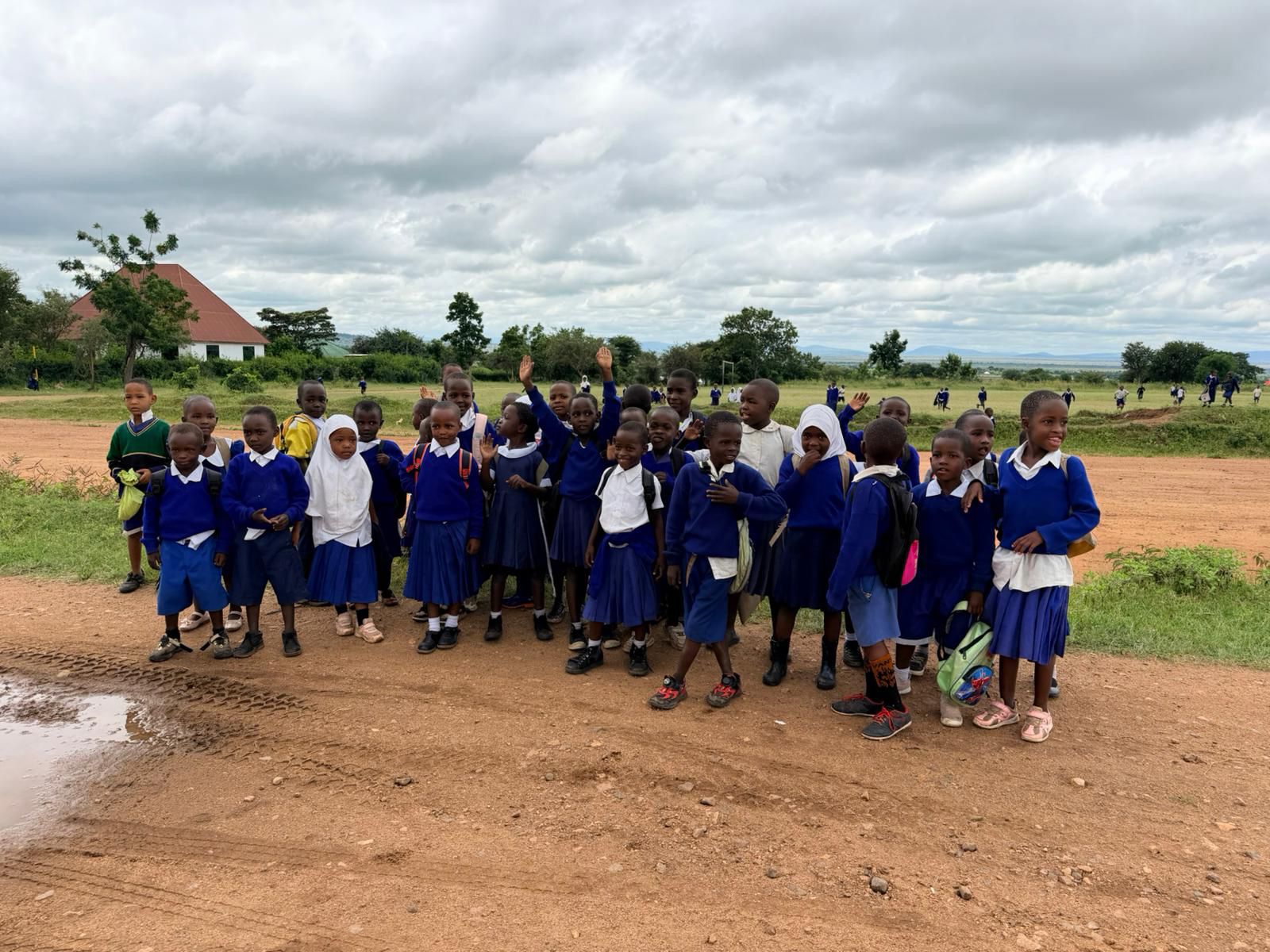
It was inspiring to see how happy and content these children are. They walk in groups with neighbors to and from school—often covering many kilometers each way. Without screens, they are full of life.
Today, we also moved from Sabora Tented Camp to Sasakwa Lodge for our final two nights.
This place is exactly what you imagine when you think of a safari lodge. It has a colonial feel, perched atop a hill with breathtaking views across the reserve. The rooms are standalone villas, and mine is the Hemingway Suite. It has space for 4–6 people, along with a private pool, terrace, and more.
Having now seen several Singita lodges—which is why I’m here, to better understand what suits each of our clients—the common thread is the exceptional level of care and attention to detail. The staff quickly become friends, while remaining incredibly attentive. Each lodge features a wine cellar, full bar, games room, cigar lounge, gym, and tennis court, among other amenities. Some lodges lean toward modern design, while others retain a traditional feel, with vintage safari photography adorning spaces like billiard rooms and conservatories where high tea is served.
It’s clear to me that Singita defines true luxury: understated, attentive, and, most importantly, tailored to each individual.
During our break today, I chose to play tennis—and Stefano, the lodge sommelier (WSET Level 3 certified), also happens to moonlight as a tennis pro. He even represented Tanzania at the junior level. We also had an askari as our ball boy. With snakes, baboons, and buffalo nearby, we were grateful not to have to retrieve my many missed shots from the tall grass.
The afternoon game drive was equally memorable. We encountered a pride of lions, a dazzle of zebras, and a journey of giraffes, among others. Sundowners were enjoyed in the middle of the plains, surrounded by gazelle.
Of course, our conversation on the court led to a proper South African wine tasting in the evening.
We turned in early, as tomorrow begins at 4:30 a.m. for a very special surprise on the final day of safari. Stay tuned!
A Different Perspective – Day 6
It’s 5am and dark outside. We’re in the Land Cruiser with the high beams on, and Eddy is driving fast. Thirty minutes from the lodge, we wind along rough roads through open fields, catching glimpses of animals’ eyes glowing in the darkness all around us.
In the distance, we spot a few other vehicles and a team working under floodlights. As we approach with growing anticipation, we realize they’re setting up a hot air balloon ride—for us.
The balloon is far bigger than I ever imagined. It feels like I’ve stepped into a movie—this is a first for me.
Jeff, our pilot, has been flying over the Serengeti for 15 years. As we climb into the basket and watch the balloon take shape, we learn that flying one isn’t about steering from point A to point B. It’s simply up, gone with the wind, and when the gas runs low—down, wherever the balloon decides to land.
Once in the air, we truly experience a different perspective. Vast herds of animals move across the Serengeti as the sun rises, casting golden light over the plains. The easiest to spot are zebras—their stripes make them look almost cartoon-like from above. Floating over a watering hole, we see crocodiles and a few hippopotamuses. Looking straight down is slightly unnerving.
Jeff soon realizes we’re heading toward the Grumeti River—a terrible place to land. Heavy overnight rains have flooded the area, and the surrounding ground has turned into swamp. The vehicles won’t be able to reach us there.
With no other option, gas running low and the river approaching fast, we land in the swamp—right among a large herd of wildebeest. Nearby, two lionesses with six cubs.
Eddy is miles away. We’re now on foot, walking through wet grass, surrounded by wildlife. Apparently, buffalo are the most dangerous and unpredictable—if they start kicking their hind legs and charging, it won’t end well.
Danger all around, it feels slightly irresponsible—and the adrenaline is high as we walk.
Eventually, Eddy finds us. Before we even get back into the vehicle, he pulls out a bottle of champagne.
There’s a story that when the French first invented the hot air balloon in 1783, they tested it by sending cattle up in the basket. When it landed, local farmers believed it was a fire-breathing dragon and prepared to attack. The inventors went to the King of France, Louis XIV and Marie-Antionette to report their success—but also the farmers’ reaction. The king suggested that from then on, every balloon flight should carry a bottle of champagne, to offer to the first people they encounter upon landing—“so they know you are French and civilized.”
I sabred that bottle with a machete in the middle of the Serengeti—covered in mud and feeling far from civilized.
Asante Sana - Day 7
As it all comes to an end, it dawns on me that I have my own herd to get home to.
I have a long journey ahead—and a lot to reflect on. My travels will take me to Kilimanjaro, then onward to Nairobi, where I’ll meet a dear friend for dinner before continuing to Toronto via Istanbul. I’ll leave the lodge on Sunday morning and arrive back to my pack on Monday night. Truly, a great migration.
Africa has most definitely left an impression. It is a truly magical continent, with—at least from what I experienced—incredible people, breathtaking landscapes, and, of course, the animals. There’s a certain sense of zen here, a peaceful energy. It’s not all hustle and chaos like the busy cities we live in.
From trekking with Gorillas, Game drives in the Serengeti and taking flight in a hot air balloon, this trip has been filled with many adventures.
As I prepare to leave, the generosity of the Singita team is evident once again, as they fill my luggage with the Pinotage I enjoyed and a bottle of Gin of Africa, which will take a proud place on my bar back home. A full group of staff came down to the airstrip to wish us farewell. I embraced Eddy, we have been through a lot these past few days.
I’m sad to leave, but deeply grateful. If you’ve made it this far, thank you for reading and following along. I have many more photos and stories, and I hope to share them with you in person.
Until then—Asante sana!


